


Description
For Numato Products Price details/ quotation please mail your requirements on dolphinlabs17@gmail.com
Numato Lab 4 Channel Ethernet Solid State Relay module allows controlling electrical devices remotely through Ethernet. This is very helpful in those situations where the device that needs to be controlled is located far from the PC and thus can not run USB cable. Numato Lab Ethernet Solid State Relay modules are designed to be very easy to set up and use.
This product has 4 onboard Solid State Relays and 10 GPIOs. Each relay/gpio can be individually controlled through the built-in easy to use web interface or through any popular terminal emulator that supports TELNET protocol. Each 4 Channel Ethernet Solid State Relay Module is shipped with a unique MAC address. These devices also support assigning and retrieving custom identification string that can be used for identifying individual devices when there is a large number of devices connected on the same network. All relay terminals are available on screw terminals which makes connecting external devices very easy.
Features
- 4 onboard Solid State Relays with individual LEDs for status.
- 3A Maximum Switching Current.
- 10 TTL (3.3V)Compatible GPIOs.
- 10 Analog Input Channels (Multiplexed with GPIOs).
- 10 bits Analog Input Resolution.
- Password-protected Web console and Telnet communication interface.
- LED indication for Power and individual relay status.
Applications
- Home Automation
- Industrial Automation
- Lighting Control
- Garden Equipment Control
- Test Fixtures
- DIY and Hobby
-
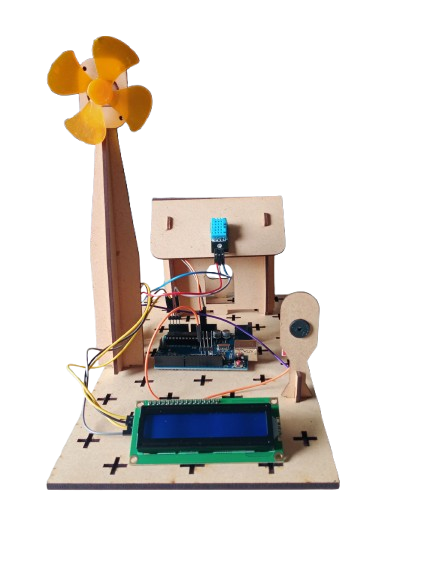
An Automatic Room Cooling is an electronic system designed to maintain a comfortable room temperature automatically. It uses a DHT11 temperature sensor to monitor the room, a DC fan for cooling, an LCD to display real-time data, and a buzzer to provide alerts. The system activates the fan automatically when the room temperature exceeds a set threshold, making it an efficient solution for homes, laboratories, and small offices.
-
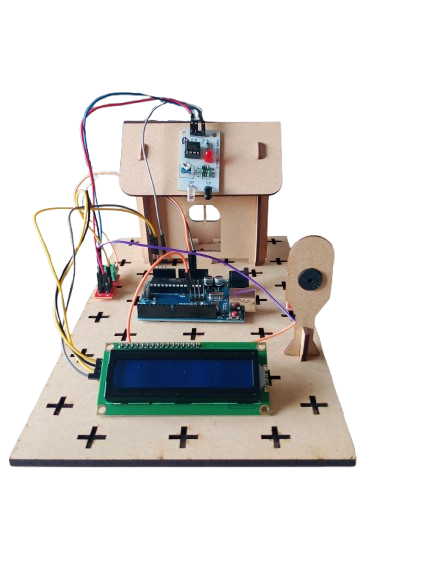
A Visitor Counter automatically counts the number of people entering or leaving a room using an IR sensor. The count is displayed on a 16×2 LCD, and a buzzer can alert when a specific limit is reached. This project is widely used in shops, libraries, offices, and events to monitor occupancy. It demonstrates sensor interfacing, counting logic, and real-time display using Arduino.
-

The Conveyor Belt Object Counter using LDR and 7-Segment Display with the 8051 microcontroller is designed to count objects passing in front of an LDR (Light Dependent Resistor) sensor. The system works by detecting light interruptions when an object crosses the sensor, causing a change in the LDR’s resistance. The microcontroller processes this change and increments an object count. The count is then displayed on a 7-segment display.
-

A DIY digital piano built using Arduino, an 8-key keypad, and a speaker, allowing users to play musical notes by pressing the keys.
₹1,400.00 -
-
 ₹136,830.00
Related products
-
-
 ₹7,321.00
 -

For Numato Products Price details/ quotation please mail your requirements on dolphinlabs17@gmail.com
₹4,245.00 -
 ₹15,559.00
 -
 ₹5,216.00
 -

For quotation / Price Please send requirements on dolphinlabs17@gmail.com
₹43,499.00

