
Out Of Stock


Description
This is double layer 4 wheel smart car robot chassis DIY kit. It comes with the four pairs of Geared Motors and Wheels. All the products included in this car kit are quality products. The chassis used in this kit is transparent so as to create dynamic handling of the components mounted on your robotic vehicle.
Features :-
- Very handy and simple in assembling/disassembling.
- Strong components so as to withstand extreme terrain conditions.
- Transparent Car Chassis.
- Attractive design.
- Double layer structure, much of mounting holes, enough space
- Easy to install a variety of control panels, sensors
- Educational toys, Ideal for DIY platform
Specifications
BO Motor:-
- Operating Voltage: 3V~6V DC
- Gear Ratio 1:48
- No-load speed(5V): about 208RPM
- Rated Torque 0.8 Kg.cm @ 5V
- Load current: 170mA (when it is 4.5V)
- Size: 70 x 23 x 18 mm
- Weight:28g
- Shaft Length: 10 mm
- Shaft Type: 6 mm, Double-D
Wheel:-
- Loading Capacity: Max 2.5Kg
- Double D hole For BO Motor: 6 mm
- Weight: 34g
- Wheel Diameter: 65 mm
- Color: Black (wheel), Yellow (Rim)
- Wheel Width: 27 mm
- Body Material: Plastic
- Grip Material: Rubber
Package includes:-
- 2 x Acrylic Transparent car floor
- 4 x High-Quality 65-mm Plastic wheels with Rubber Grip
- 4 x Dual shaft 200 RPM BO Gear Motor
- 4 x Coded Disk
- 8 x Acrylic Fasteners
- 1 x 4-AAA Battery Holder
- 6 x Connecting Cable(Red and Black)
- 6 x M3 Copper Stand-Off (Male-Female)
- 6 x M3 Cross-Head Bolt (Length: 8 mm )
- 8 x M3 Cross-Head Bolt (Length: 30 mm )
- 16 x M3 Nut
* product image for illustration purposes only. actual product may vary.
-
 ₹5,216.00
 -

An object-avoidance robot is a type of autonomous robot designed to detect and avoid obstacles.
₹1,250.00 -
 ₹3,310.00
 -
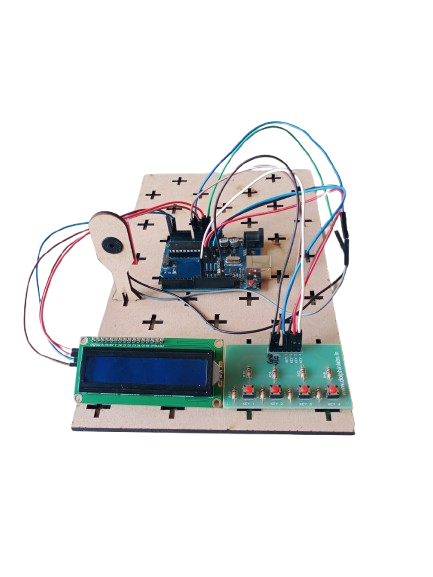
A Reaction Time Game is an interactive electronic project designed to measure a user’s response speed. Using an Arduino, keypad, buzzer, and LCD, the system tests how quickly a player can respond to a visual or auditory signal. This project is widely used in educational setups, gaming, and psychology experiments to study reflexes and reaction times.
-
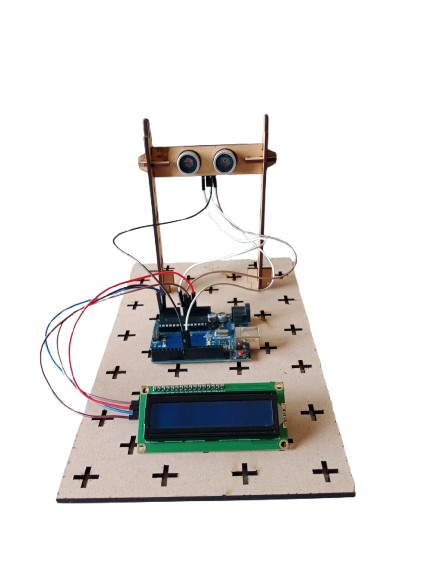
A digital ruler is an electronic measuring device that provides precise measurements of length, width, or depth. Unlike traditional rulers or tape measures, digital rulers use sensors and electronic displays (often LCD or LED) to show measurements accurately, usually in both metric (mm/cm) and imperial (inches) units. They are widely used in engineering, design, woodworking, tailoring, and education where precision is critical.
-

A Soil Moisture Detection System using Arduino, a soil moisture sensor, and a buzzer that sounds an alert when soil moisture is detected.
Related products
-

Photo phobic robot will sense the light and will try to move away from light. On the contrary photo phobic is exactly opposite where it does not follow the light or more precisely it avoids and goes to places where there is less light
₹1,250.00 -
An object-avoidance robot is a type of autonomous robot designed to detect and avoid obstacles.
₹1,250.00 -
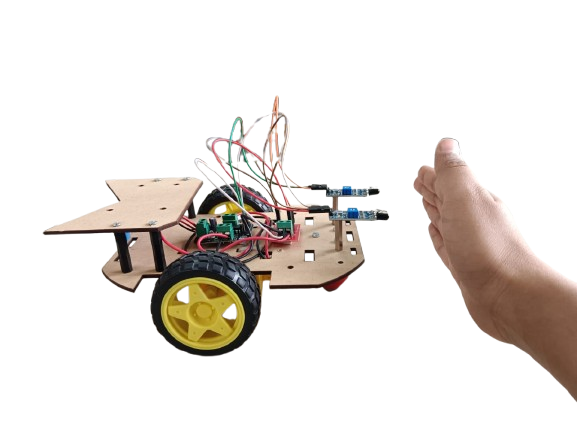
The basic function of this robot is simple, it follows object. It goes forward as you go forward; goes backward as you go backward; turns left/right as you turn left/right.
₹1,250.00 -

The term photo maniac implies attraction towards light. These robots actually follow the light using a set of sensors which are also called positive prototroph.
₹1,250.00

