

Automatic Watering System
In Stock
The Automatic Watering System provides an efficient, reliable, and convenient way to maintain soil moisture levels without human intervention. By using sensors and a microcontroller, the system ensures that plants receive the right amount of water at the right time, reducing water wastage and promoting healthy plant growth. It is an eco-friendly solution that saves time, energy, and resources, making it ideal for both domestic and agricultural use.
Description
An Automatic Watering System (also called an Automatic Plant Irrigation System) is designed to supply water to plants automatically based on soil moisture levels. It uses a soil moisture sensor to detect the dryness of the soil and a microcontroller (such as Arduino, Raspberry Pi, or FPGA) to control a water pump or solenoid valve. When the soil becomes dry, the system turns ON the pump to water the plants and stops when the desired moisture level is reached. This ensures optimal plant growth, saves water, and reduces human effort.
Features
- Automatic detection of soil moisture using sensors.
- Microcontroller-based control for efficient watering.
- Water-saving operation by preventing over-irrigation.
- Manual/Automatic mode selection (optional).
- Real-time monitoring using IoT or GSM modules (optional).
- Low power consumption and compact setup.
Applications
- Home gardens and indoor plants.
- Agricultural farms and greenhouses.
- Parks and public gardens.
- Plant nurseries and landscaping systems.
- Smart irrigation in remote or urban areas.
Advantages
- Saves time, water, and energy.
- Reduces human intervention.
- Provides consistent irrigation for better plant health.
- Can be automated using renewable energy (solar).
- Scalable and easy to integrate with IoT systems.
Disadvantages
- Sensor calibration required for accurate operation.
- Initial setup cost can be higher than manual watering.
- Depends on electricity or battery power.
- Sensors may degrade over time due to moisture exposure.
- Limited performance if water pressure or supply is inconsistent.
Related products
-
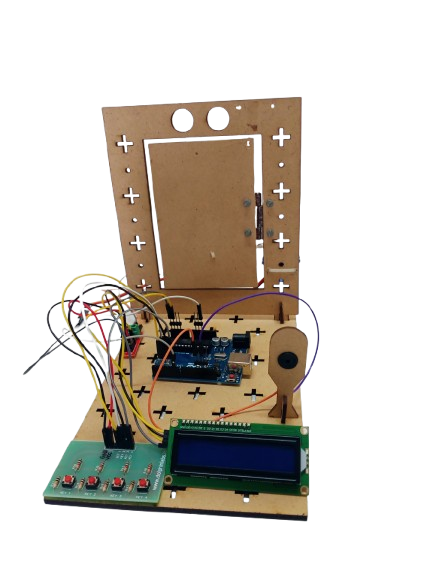
A Digital Lock System is an electronic security project designed to control access using a password entered via a keypad. It utilizes an Arduino, keypad, LCD, servo motor, and buzzer to provide a safe, automated locking mechanism. When the correct password is entered, the lock opens; if the wrong password is entered, an alert is triggered. This project is widely used in home security, lockers, safes, and access-controlled systems.
-

An Arduino-based smart fan that automatically adjusts its speed according to temperature changes using an LM35 sensor and a DC motor driver.
₹1,350.00 -

A DIY digital piano built using Arduino, an 8-key keypad, and a speaker, allowing users to play musical notes by pressing the keys.
₹1,400.00 -
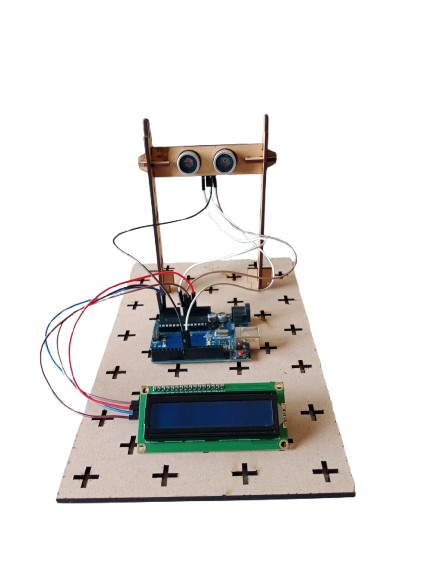
A digital ruler is an electronic measuring device that provides precise measurements of length, width, or depth. Unlike traditional rulers or tape measures, digital rulers use sensors and electronic displays (often LCD or LED) to show measurements accurately, usually in both metric (mm/cm) and imperial (inches) units. They are widely used in engineering, design, woodworking, tailoring, and education where precision is critical.
-
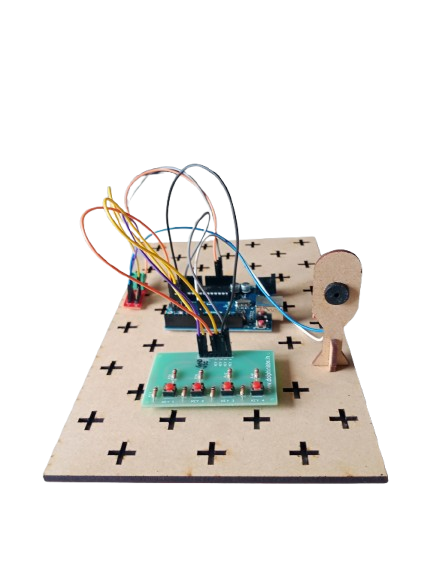
A Morse Code Generator is an electronic project designed to convert text input into Morse code signals using Arduino, a keypad, and a buzzer. Morse code is a method of encoding text characters as sequences of dots and dashes, widely used in communication systems, especially in emergency signaling and amateur radio. This project demonstrates signal encoding, microcontroller programming, and interactive electronics.
-

A Rain Detection System using Arduino, a rain sensor, and a buzzer that sounds an alert when water droplets or rain are detected.

