


Description
For Numato Products Price details/ quotation please mail your requirements on dolphinlabs17@gmail.com
Callisto K7 is an easy-to-use FPGA Module featuring the AMD Kintex 7 FPGA with 4Gb DDR3 SDRAM. This board contains the AMD XC7K410T– FBG676 FPGA. The high-speed USB 3.1 interface (USB-C connector) provides a fast and easy configuration download to the onboard SPI flash. There is no need for a programmer or special downloader cable to download Bitstream to the board. The FPGA Module also provides easy access to JTAG signals on a standard Xilinx Platform Cable compatible header. Callisto K7 provides the user with the flexibility of adding their own peripherals through IO Expansion Headers.
Features
- FPGA: AMD XC7K410T in FBG676 package
- DDR3: 4Gb DDR3 (MT41J256M16HA-125:K or equivalent)
- Flash memory: 512 Mb Quadbit SPI flash memory (S25FL512SDSBHV210/IS25LP512M-RHLE)
- 1 x 100MHz CMOS oscillator
- USB 3.1 Gen1 @5Gbps (USB Type-C connector)
- Onboard voltage regulators for single power rail operation
- 12V DC power supply
- A Push Button for the reset pin
- JTAG header for programming and debugging
- 274 IOs for user-defined purposes
- All user IOs are length matched and can be used as differential pairs
Applications
- Product Prototype Development
- Communication Device Development
- Accelerated Computing Integration
- Development and Testing of Custom embedded processors
- Signal Processing
- Educational tool for Schools and Universities
-
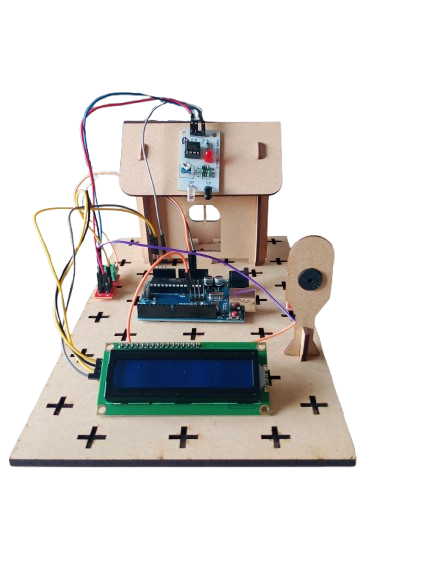
A Visitor Counter automatically counts the number of people entering or leaving a room using an IR sensor. The count is displayed on a 16×2 LCD, and a buzzer can alert when a specific limit is reached. This project is widely used in shops, libraries, offices, and events to monitor occupancy. It demonstrates sensor interfacing, counting logic, and real-time display using Arduino.
-
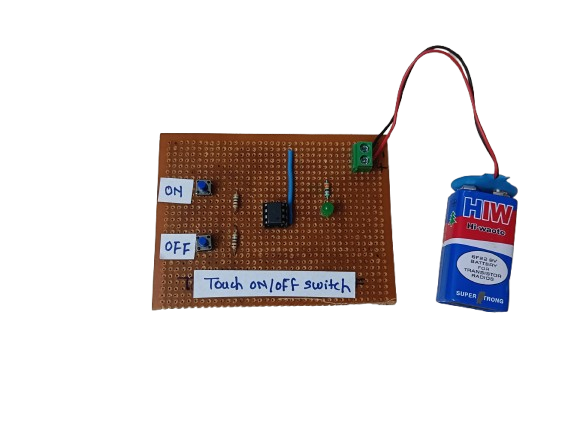
A Touch ON/OFF Switch is an electronic circuit that allows a device to be turned on or off by simply touching a sensor pad or wire, instead of using a mechanical switch. It works by detecting a small electrical signal from the human body (capacitive or resistive touch) and using that to toggle the output state.
These switches are commonly used in modern electronics, home automation, and DIY projects due to their durability, aesthetic appeal, and user-friendly operation.
₹150.00 -

The Conveyor Belt Object Counter using LDR and 7-Segment Display with the 8051 microcontroller is designed to count objects passing in front of an LDR (Light Dependent Resistor) sensor. The system works by detecting light interruptions when an object crosses the sensor, causing a change in the LDR’s resistance. The microcontroller processes this change and increments an object count. The count is then displayed on a 7-segment display.
-
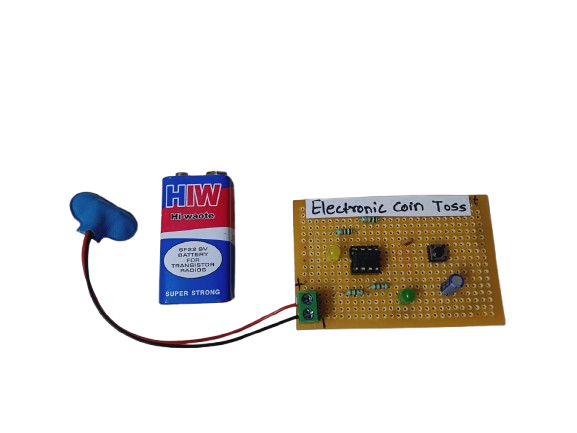
The Electronic Coin Toss is a simple, fun, and educational project that replaces a physical coin with digital logic or microcontroller-based randomness. It’s ideal for learning basic electronics, understanding random number generation, and creating a useful and entertaining tool.
₹190.00 -
For Numato Products Price details/ quotation please mail your requirements on dolphinlabs17@gmail.com
₹25,890.00 -
 ₹6,524.00
Related products
-

For Numato Products Price details/ quotation please mail your requirements on dolphinlabs17@gmail.com
₹4,245.00 -
 ₹5,241.00
 -

For quotation / Price Please send requirements on dolphinlabs17@gmail.com
₹43,499.00 -
For Numato Products Price details/ quotation please mail your requirements on dolphinlabs17@gmail.com
₹25,890.00 -
 ₹15,559.00
 -
 ₹15,559.00

