Digital Ruler
In Stock
A digital ruler is an electronic measuring device that provides precise measurements of length, width, or depth. Unlike traditional rulers or tape measures, digital rulers use sensors and electronic displays (often LCD or LED) to show measurements accurately, usually in both metric (mm/cm) and imperial (inches) units. They are widely used in engineering, design, woodworking, tailoring, and education where precision is critical.
Description
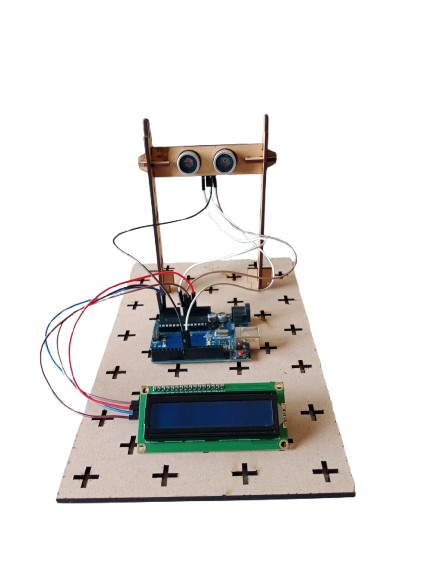
The Digital Ruler is an electronic measuring device designed to measure distance accurately using sensors such as an ultrasonic or infrared sensor. The sensor detects the distance to an object, and a microcontroller processes this data to display the result on an LCD or LED screen. This system provides quick, precise, and error-free measurements compared to a traditional ruler. It is especially useful for measuring objects that are far away or difficult to reach. The device can also include features like unit conversion and auto calibration for better usability. Overall, the Digital Ruler makes measurement easier, smarter, and more efficient.
Features
- Digital Display – Shows measurements clearly in numerical format.
- Unit Conversion – Switch between metric and imperial units.
- High Accuracy – Can measure to fractions of a millimeter or inch.
- Memory Function – Some models can store measurements for later use.
- Durable Material – Often made from stainless steel, aluminum, or strong plastic.
- Zero-Reset Function – Allows resetting the measurement at any point.
- Portable & Lightweight – Easy to carry and use on-site.
- Auto Power-Off – Conserves battery life when not in use.
Applications of Digital Ruler
- Engineering & Manufacturing – For precise measurement of components.
- Woodworking & Metalworking – Accurate measurement for cutting and fitting materials.
- Tailoring & Fashion – Measuring fabrics and body dimensions.
- Education & Laboratories – Teaching measurement concepts and conducting experiments.
- Medical Field – Measuring body parts or wounds in healthcare applications.
Advantages of Digital Ruler
- High Precision – Provides more accurate readings than traditional rulers.
- Easy to Read – Digital display avoids errors in interpreting small marks.
- Unit Flexibility – Easy conversion between metric and imperial.
- Time-Saving – Faster than manual measurement and calculation.
- Compact & Portable – Can be carried and used in various environments.
Disadvantages of Digital Ruler
- Battery Dependency – Requires power, usually batteries, to function.
- Higher Cost – More expensive than traditional rulers or tape measures.
- Fragility – Sensitive electronics can be damaged if dropped or exposed to water.
- Calibration Needed – May require periodic calibration to maintain accuracy.
- Limited Range – Usually smaller than tape measures for very long measurements.
- Complexity – Some users may find digital features confusing compared to a simple ruler.
The Digital Ruler project demonstrates how sensors and microcontrollers can be combined to create a modern and accurate measuring tool. It reduces human error and provides fast, reliable distance readings. This project highlights the usefulness of digital measurement systems in daily life and technical fields.
-

The Conveyor Belt Object Counter using LDR and 7-Segment Display with the 8051 microcontroller is designed to count objects passing in front of an LDR (Light Dependent Resistor) sensor. The system works by detecting light interruptions when an object crosses the sensor, causing a change in the LDR’s resistance. The microcontroller processes this change and increments an object count. The count is then displayed on a 7-segment display.
-

Photo phobic robot will sense the light and will try to move away from light. On the contrary photo phobic is exactly opposite where it does not follow the light or more precisely it avoids and goes to places where there is less light
₹1,250.00 -

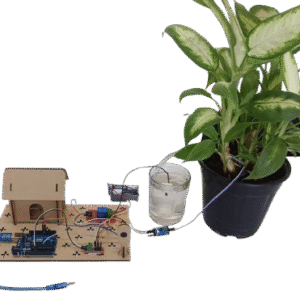
The Automatic Watering System provides an efficient, reliable, and convenient way to maintain soil moisture levels without human intervention. By using sensors and a microcontroller, the system ensures that plants receive the right amount of water at the right time, reducing water wastage and promoting healthy plant growth. It is an eco-friendly solution that saves time, energy, and resources, making it ideal for both domestic and agricultural use.
-

A digital code lock system with a buzzer and servo motor is an embedded project that enhances security. When the correct code is entered, the microcontroller triggers a servo motor to unlock a door or container. If an incorrect code is entered, a buzzer sounds as an alert.
-
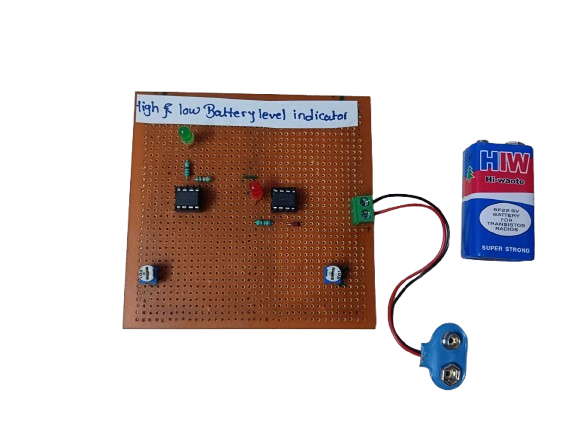
A Battery High-Low Monitor is an electronic circuit or device that detects and indicates the voltage level of a battery — whether it’s too high (overcharged), normal, or too low (discharged). It helps protect batteries from overcharging or deep discharge, which can damage the battery or reduce its lifespan.
These monitors often use comparators, voltage dividers, LED indicators, or microcontrollers to track and display battery status in real time.
₹225.00 -
 ₹6,524.00
Related products
-
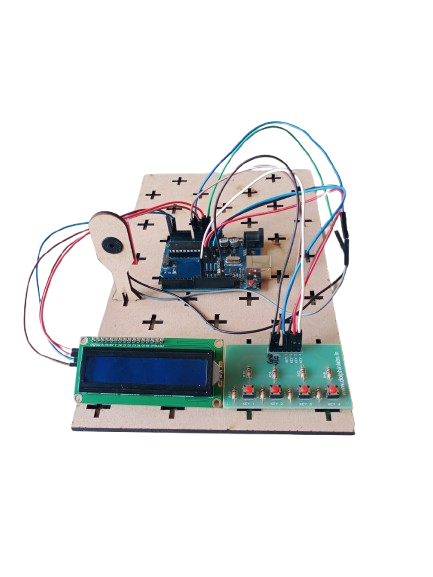
A Reaction Time Game is an interactive electronic project designed to measure a user’s response speed. Using an Arduino, keypad, buzzer, and LCD, the system tests how quickly a player can respond to a visual or auditory signal. This project is widely used in educational setups, gaming, and psychology experiments to study reflexes and reaction times.
-
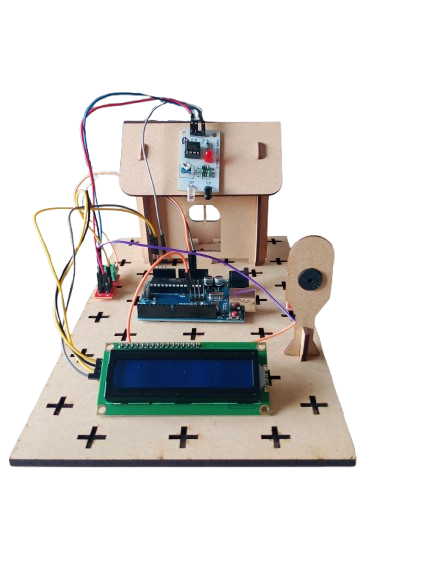
A Visitor Counter automatically counts the number of people entering or leaving a room using an IR sensor. The count is displayed on a 16×2 LCD, and a buzzer can alert when a specific limit is reached. This project is widely used in shops, libraries, offices, and events to monitor occupancy. It demonstrates sensor interfacing, counting logic, and real-time display using Arduino.
-

A Soil Moisture Detection System using Arduino, a soil moisture sensor, and a buzzer that sounds an alert when soil moisture is detected.
-

A Rain Detection System using Arduino, a rain sensor, and a buzzer that sounds an alert when water droplets or rain are detected.
-

A Temperature and Humidity Monitoring System using Arduino and a DHT11 sensor that measures and displays real-time temperature and humidity data on the serial monitor.
-

An Arduino Theremin using Arduino, an ultrasonic sensor, and a speaker that produces varying sound pitches based on the distance of an object from the sensor.