Description
For Numato Products Price details/ quotation please mail your requirements on dolphinlabs17@gmail.com
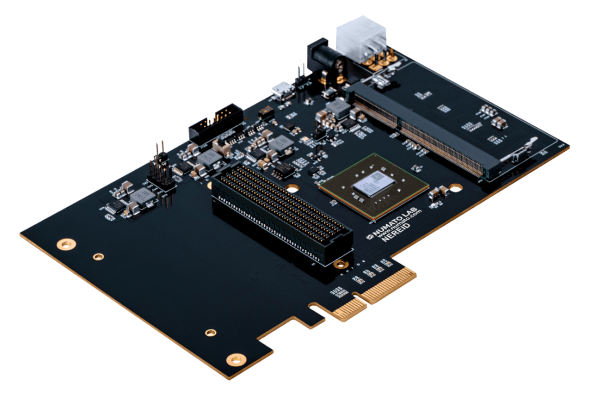
Nereid is an easy-to-use FPGA Development board featuring AMD Kintex-7 FPGA with x4 PCIe interface and 4GB DDR3 SDRAM. The board has AMD XC7K160T– FBG676 FPGA; other FPGA configurations are available at request. Nereid features a High Pin Count (HPC) high-speed FMC connector for the purpose of adding additional features to the board by using custom or commercial off-the-shelf daughter boards.
- FPGA: AMD Kintex-7 XC7K160T in -1 FBG676 package (Other devices available at request)
- 4 lane PCIe Gen2.0 (5GT/s)
- 4GB DDR3L SODIMM SDRAM M471B5173CB0-YK0 or compatible
- 128 Mb QSPI flash memory
- USB to UART serial converter
- 1 x 100MHz CMOS oscillator, 1x 150MHz LVDS oscillator for users
- 1 x 150MHz LVDS oscillator for GTP
- Maximum 174 IOs for user-defined purposes on ANSI/VITA 57.1 Standard compliant FMC HPC connector
- 4x GTP lanes up to 6.6Gbps on ANSI/VITA 57.1 Standard compliant FMC HPC connector
Applications
- Parallel Processing and Accelerators
- Product Prototype Development
- Development and Testing of custom embedded processors
- Signal Processing
- Communication Devices Development
- Data Acquisition
- Educational tool for Schools and Universities
Related products
-
 ₹6,295.00
 -
 ₹15,559.00
 -
 ₹5,216.00
 -

For Numato Products Price details/ quotation please mail your requirements on dolphinlabs17@gmail.com
₹5,480.00 -
-
 ₹25,245.00