
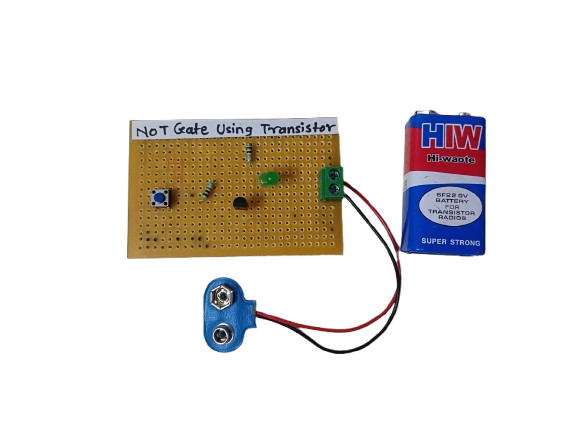
NOT Gate Using Transistor


In Stock
A NOT gate (or inverter) using a transistor is a simple digital logic circuit that outputs the opposite of the input signal. If the input is HIGH (1), the output is LOW (0), and vice versa. It’s built using a single NPN transistor and a few passive components.
Description
The NOT gate, also known as an inverter, is a fundamental digital logic gate that outputs the logical complement of its input. Implementing a NOT gate using a transistor is a basic and educational way to understand how logic gates function at the hardware level.
In a transistor-based NOT gate:
- When the input is HIGH (logic 1), the transistor turns ON, creating a path to ground, so the output is pulled LOW (logic 0).
- When the input is LOW (logic 0), the transistor remains OFF, and the output stays HIGH via a pull-up resistor.
Applications:
- Basic Logic Circuits
- Used in building more complex logic gates.
- Signal Inversion
- Inverts control signals in microcontroller or digital circuits.
- Microcontroller Interfaces
- Convert active-high signals to active-low and vice versa.
- Educational Purposes
- Demonstrates how digital logic works at the hardware level.
- Noise Filtering :-In some cases, helps clean up signals before processing.
Related products
-

A Panic Alarm Button is a simple safety device that, when pressed, immediately activates a loud alarm, buzzer, or alert system to signal an emergency or request for help. It’s commonly used in homes, banks, hospitals, and personal security systems.
₹160.00 -
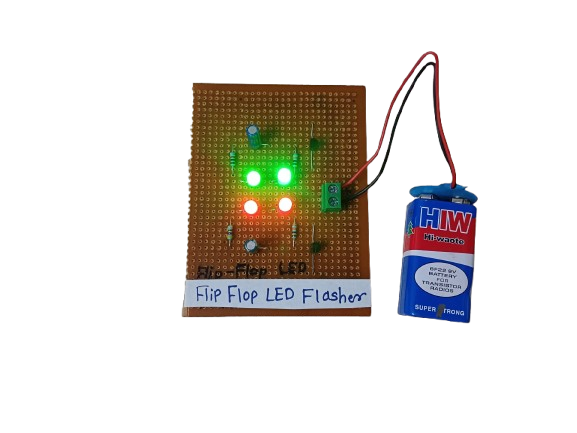
A Flip-Flop LED Flasher is a simple electronic circuit that alternately turns two LEDs on and off in a continuous loop, creating a blinking or “flashing” effect. It’s commonly built using transistors, resistors, capacitors, and LEDs, forming an astable multivibrator — a basic circuit that oscillates between two states without any external triggering.
It’s often used for decoration, indicators, or learning basic electronics.
₹175.00 -

A Hall Effect Alarm is a type of security or position-detection system that uses a Hall Effect sensor to detect the presence or movement of a magnet. When the magnetic field changes (such as a magnet being removed or moved), the circuit triggers an alarm (buzzer, LED, relay, etc.).
₹210.00 -
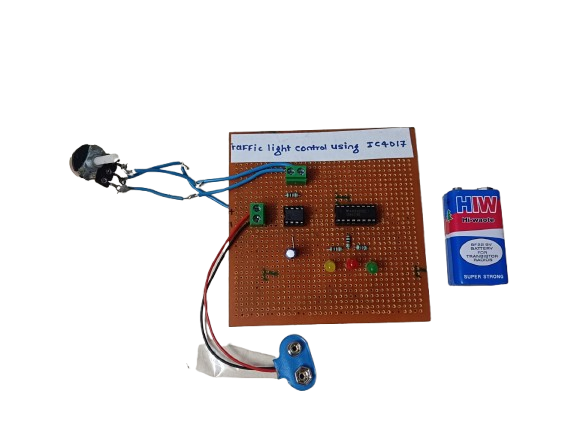
A traffic light control circuit using IC CD4017 is a simple digital electronics project that mimics the working of a real traffic light system. It uses the CD4017 decade counter IC along with a timer (usually 555 IC) to sequentially switch Red, Yellow, and Green LEDs, simulating the flow of traffic signals.
₹250.00 -
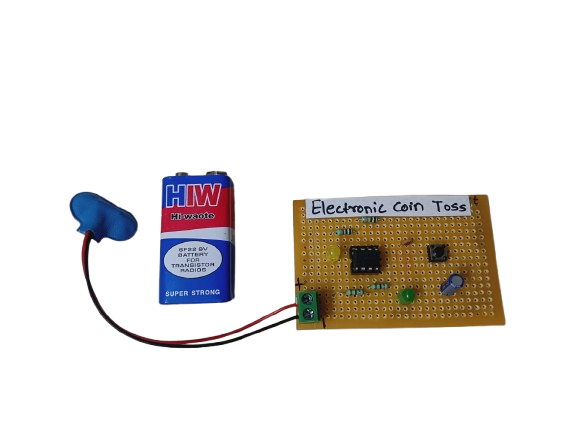
An Electronic Coin Toss circuit is an electronic version of the classic coin flip — often used to make quick decisions, settle disputes, or play games. It mimics the randomness of a real coin toss using digital logic or a microcontroller to generate a pseudo-random result and display it using LEDs or a text display (e.g., “Heads” or “Tails”).
₹160.00 -
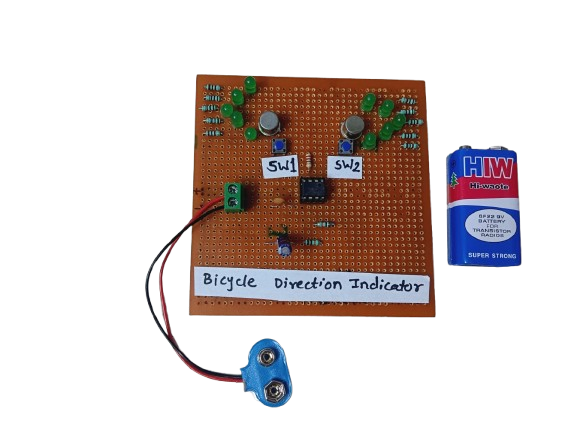
A Bicycle Direction Indicator is a safety system that uses LEDs or blinkers to signal the rider’s left or right turn intentions, just like car indicators. It’s often controlled by push buttons, switches, or microcontrollers.
₹180.00