Visitor Counter
In Stock
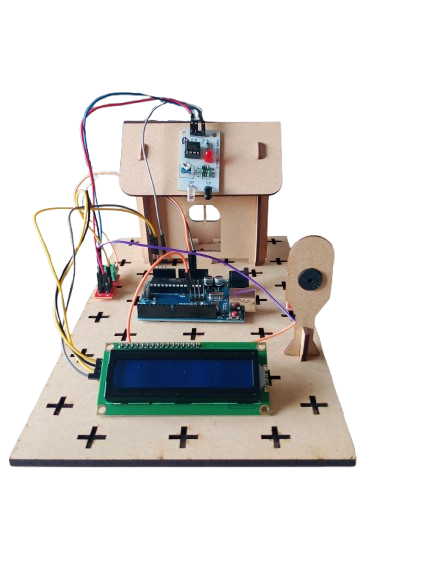
A Visitor Counter automatically counts the number of people entering or leaving a room using an IR sensor. The count is displayed on a 16×2 LCD, and a buzzer can alert when a specific limit is reached. This project is widely used in shops, libraries, offices, and events to monitor occupancy. It demonstrates sensor interfacing, counting logic, and real-time display using Arduino.
Description
A Visitor Counter using Arduino is an electronic system designed to automatically count the number of people entering or exiting a room or building. It typically uses sensors like IR (infrared) sensors, ultrasonic sensors, or motion detectors to detect movement, and the Arduino micro-controller processes the data to update the count. This system helps monitor occupancy, manage crowd control, and analyse visitor flow in places like offices, libraries, malls, and exhibitions.
Features
- Automatic Counting – Counts visitors entering and exiting without manual intervention.
- Real-Time Display – Shows the current number of visitors on an LCD or 7-segment display.
- Bidirectional Counting – Can distinguish between entry and exit.
- Sensor-Based Detection – Uses IR, ultrasonic, or motion sensors for accurate detection.
- Microcontroller Control – Arduino processes sensor data efficiently.
- Compact & Low-Power – Small, portable design with minimal power consumption.
- Programmable – Can set limits or trigger alerts when a maximum capacity is reached.
Applications
- Offices & Workplaces – Monitor occupancy and ensure safety regulations.
- Libraries & Museums – Track footfall and visitor trends.
- Retail Stores & Malls – Analyze customer traffic for business insights.
- Events & Exhibitions – Count attendees for better crowd management.
- Public Transport & Facilities – Monitor usage of buses, trains, or public halls.
Advantages
- Accurate Counting – Reduces human error in manual counting.
- Real-Time Monitoring – Immediate updates on visitor numbers.
- Easy Integration – Can be combined with alarms, displays, or databases.
- Cost-Effective – Low-cost solution using Arduino and basic sensors.
- Automation – Eliminates the need for a dedicated person to count visitors.
- Data Collection – Helps analyze visitor trends over time.
Disadvantages
- Sensor Limitations – May miscount if multiple people pass simultaneously.
- Power Dependence – Requires continuous power supply.
- Environmental Sensitivity – Dust, sunlight, or obstacles can affect sensor accuracy.
- Limited Range – IR or ultrasonic sensors have distance constraints.
- Maintenance Needed – Sensors and display may require periodic check.
The Visitor Counter project demonstrates real-time monitoring of people entering a room using Arduino, IR sensors, LCD, and a buzzer. It provides an efficient and automated method to track occupancy, helping in crowd management and safety compliance.This project is a simple yet effective introduction to sensor interfacing, counting logic, and real-time display in embedded systems.
-

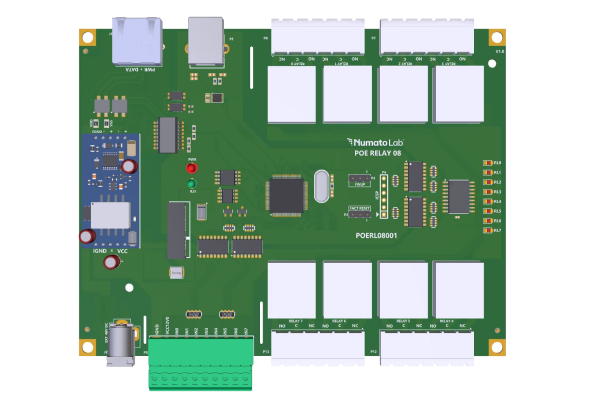
- A rain alert system with an LCD display and buzzer, controlled by an 8051 microcontroller, is designed to detect rainfall and provide real-time notifications. The system uses a rain sensor to detect moisture or rainfall, and the microcontroller processes the sensor data. When rain is detected, the 8051 triggers a buzzer to alert the user audibly and displays the rain status on an LCD screen.
-
-
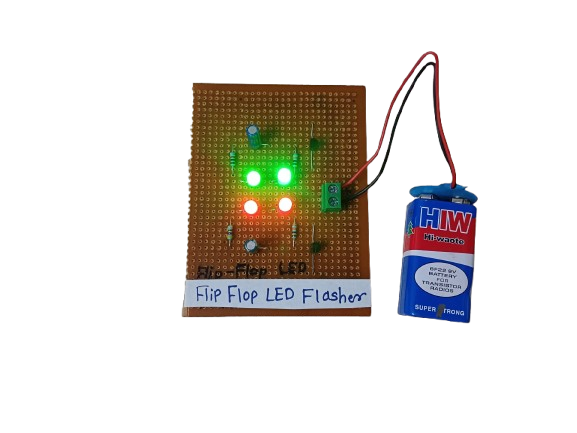
A Flip-Flop LED Flasher is a simple electronic circuit that alternately turns two LEDs on and off in a continuous loop, creating a blinking or “flashing” effect. It’s commonly built using transistors, resistors, capacitors, and LEDs, forming an astable multivibrator — a basic circuit that oscillates between two states without any external triggering.
It’s often used for decoration, indicators, or learning basic electronics.
₹175.00 -

A Temperature and Humidity Monitoring System using Arduino and a DHT11 sensor that measures and displays real-time temperature and humidity data on the serial monitor.
-
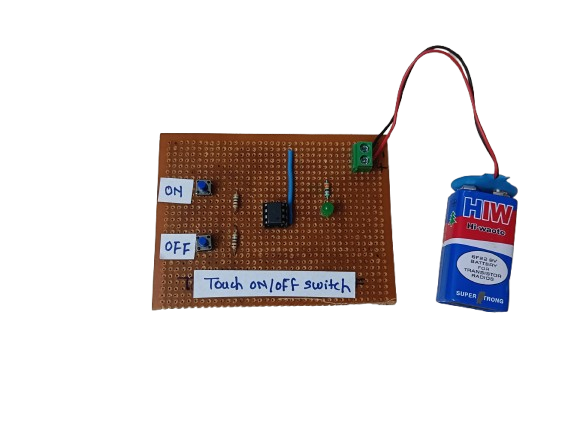
A Touch ON/OFF Switch is an electronic circuit that allows a device to be turned on or off by simply touching a sensor pad or wire, instead of using a mechanical switch. It works by detecting a small electrical signal from the human body (capacitive or resistive touch) and using that to toggle the output state.
These switches are commonly used in modern electronics, home automation, and DIY projects due to their durability, aesthetic appeal, and user-friendly operation.
₹150.00

Related products
-
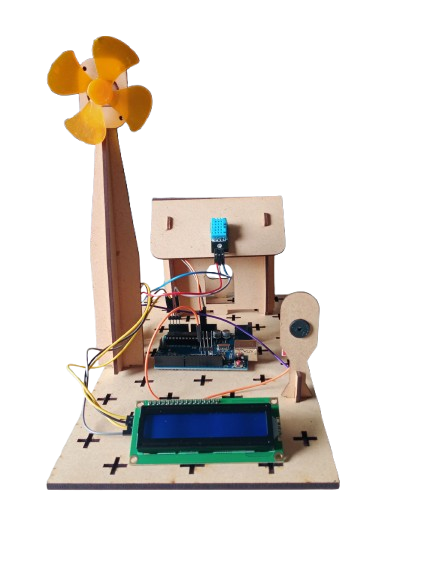
An Automatic Room Cooling is an electronic system designed to maintain a comfortable room temperature automatically. It uses a DHT11 temperature sensor to monitor the room, a DC fan for cooling, an LCD to display real-time data, and a buzzer to provide alerts. The system activates the fan automatically when the room temperature exceeds a set threshold, making it an efficient solution for homes, laboratories, and small offices.
-

An Arduino-based smart fan that automatically turns ON or OFF based on proximity detection using an ultrasonic sensor and controls speed using a DC motor driver.
₹1,450.00 -
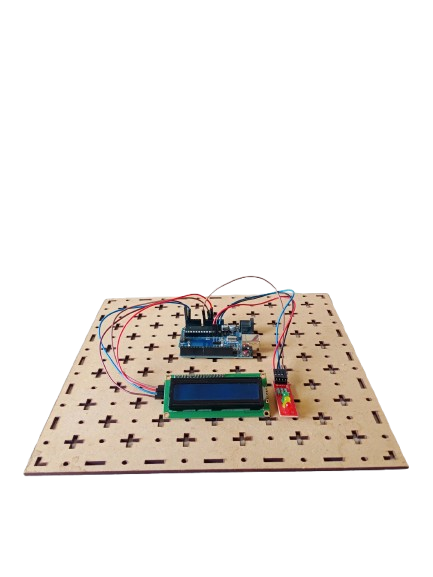
A Traffic Light Signal is an electronic project designed to manage vehicle and pedestrian traffic at intersections. Using Arduino, LEDs (Red, Yellow, Green), and an LCD, the system simulates real-world traffic light behavior, displaying signal changes with appropriate timing. This project demonstrates traffic management, embedded system programming, and microcontroller-based automation.
-

A Rain Detection System using Arduino, a rain sensor, and a buzzer that sounds an alert when water droplets or rain are detected.
-
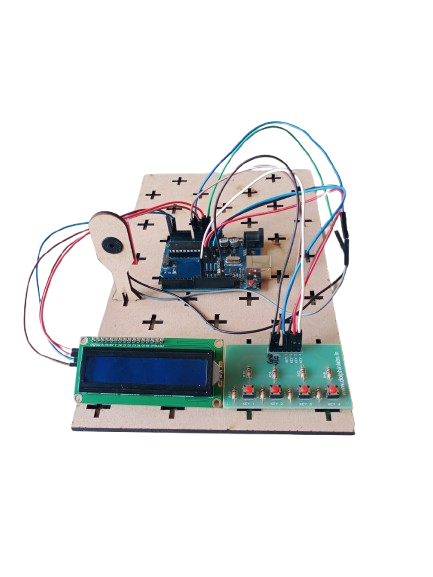
A Reaction Time Game is an interactive electronic project designed to measure a user’s response speed. Using an Arduino, keypad, buzzer, and LCD, the system tests how quickly a player can respond to a visual or auditory signal. This project is widely used in educational setups, gaming, and psychology experiments to study reflexes and reaction times.
-
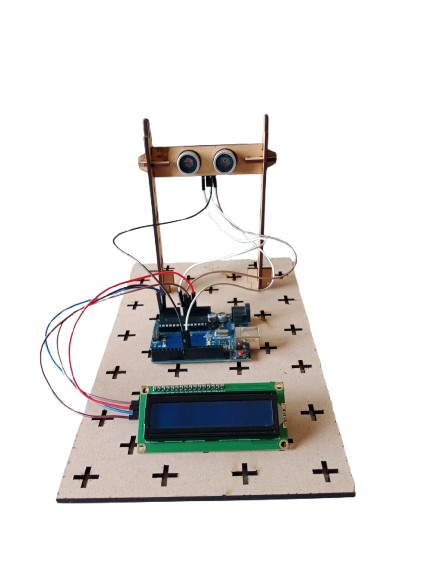
A digital ruler is an electronic measuring device that provides precise measurements of length, width, or depth. Unlike traditional rulers or tape measures, digital rulers use sensors and electronic displays (often LCD or LED) to show measurements accurately, usually in both metric (mm/cm) and imperial (inches) units. They are widely used in engineering, design, woodworking, tailoring, and education where precision is critical.